Role: Biomedical Engineering Co-op | Embedded Systems & Signal Processing Lead
Timeline: May–August 2024
Organization: The KITE Research Institute (Toronto Rehab)
Overview
This project focused on redesigning and optimizing a handheld surface electromyography (sEMG) device intended for physiotherapists and occupational therapists. The goal was to transform an early-stage prototype into a clinically viable tool for real-time muscle activity monitoring with improved signal quality, usability, and system performance.
Design Objectives
- Enable accurate, real-time visualization of sEMG signals in a compact handheld form
- Improve signal quality through digital filtering and optimized data handling
- Redesign hardware and firmware for efficient processing and clinician-friendly operation
Key Features
🔹 Hardware Integration
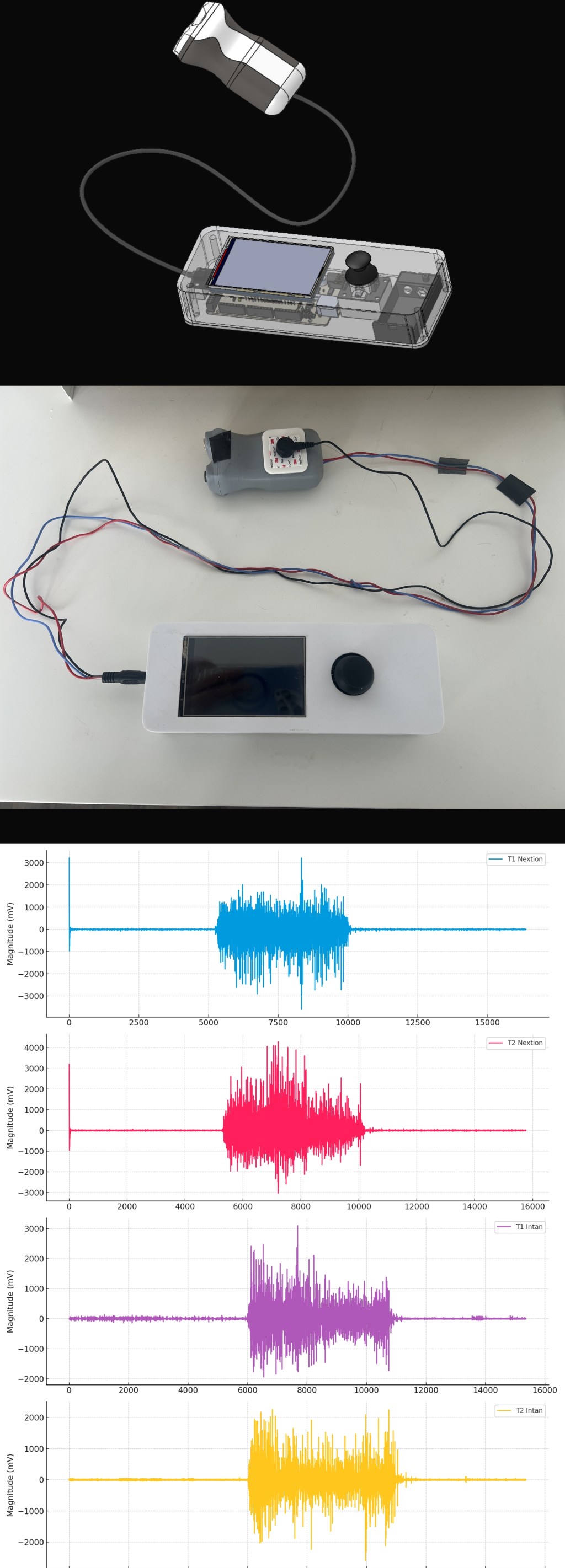
- Integrated a Nextion 3.5” touchscreen to offload graphical processing and improve frame rate
- Achieved stable 1kHz sampling rate for reliable EMG acquisition
- Redesigned the handheld enclosure to support physical controls, electrode ports, and future expansions
🔹 Signal Processing & Firmware
- Implemented digital filters (bandpass and notch) to reduce interference and boost clarity
- Structured firmware to maintain real-time acquisition + touch-based UI control
- Included simple gesture logic (e.g., left-tap to pause, right-tap to return) for in-clinic usability
🔹 Prototyping & Validation
- Built and validated a working prototype tested with both wet and dry electrodes
- Captured high-fidelity EMG data from multiple muscles (e.g., biceps, forearm flexors) under controlled conditions
Skills Applied
- Embedded programming with Arduino IDE + Nextion Editor
- Digital signal processing (real-time EMG filtering, FFT concepts)
- 3D modeling and fabrication for handheld electronics
- UI logic design for touchscreen interactions
- Team collaboration with clinicians and biomedical engineers
Deliverables
- Functional sEMG device prototype
- CAD files, firmware, and internal documentation package
- Performance benchmarks, including sampling validation and filter comparisons
Future Directions
- Integrate a higher-performance MCU (e.g., Raspberry Pi with DMA support)
- Add SD card logging for offline EMG analysis
- Upgrade to a high-refresh-rate LCD for smoother signal rendering
IP & Confidentiality Note
Detailed firmware structure, analog front-end specs, and internal calibration logic are withheld to protect intellectual property and future research development.
 Danniel | Xingyu Hu